The Price of Quiet: How Acoustic Inequality Is Reshaping Urban Residential Markets
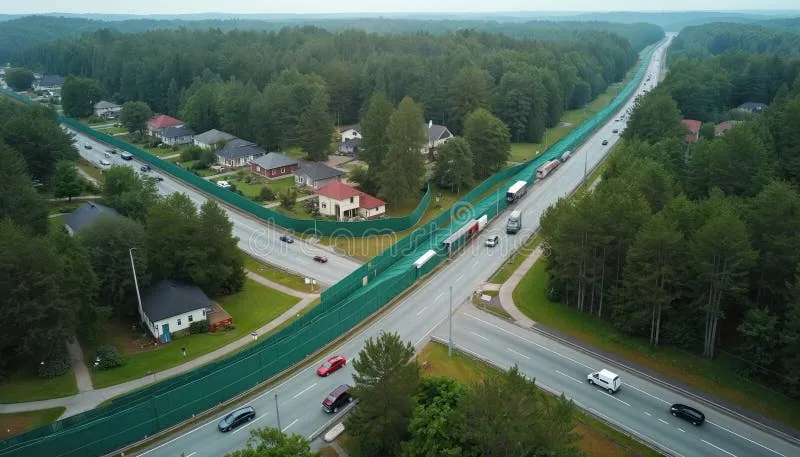
Photo: urban highway noise barrier residential neighborhood aerial city traffic, via thumbs.dreamstime.com
In American cities, the ability to sleep through the night without highway noise has a price. So does the ability to work from home without street-level disruption, to hold a conversation on a balcony, or to step outside in the morning without the ambient roar of urban infrastructure pressing against the senses. That price is, increasingly, correlated with income—and the gap between what wealthy urban residents experience acoustically and what lower-income residents endure has grown wide enough to constitute a distinct dimension of urban inequality.
Noise is not a trivial concern. The World Health Organization classifies chronic noise exposure as a serious environmental health risk, linking it to elevated rates of cardiovascular disease, sleep disruption, cognitive impairment in children, and mental health deterioration. The U.S. Environmental Protection Agency has maintained noise pollution guidelines since the 1970s, though enforcement mechanisms have weakened considerably over subsequent decades. What has not weakened is the underlying public health data, which continues to accumulate: sustained exposure to elevated noise levels carries measurable physiological costs, and those costs are distributed unequally across American cities.
How the Market Encodes Sound
Real estate markets have long priced location in ways that implicitly encode acoustic conditions. A unit facing a quiet interior courtyard commands a premium over one facing a busy arterial street. A neighborhood buffered from highway infrastructure by commercial zoning or topography carries higher residential values than one directly adjacent to an interchange. These relationships are intuitive to anyone who has searched for an apartment in a major city.
What is less commonly discussed is the degree to which this pricing reflects a systematic transfer of acoustic burden onto lower-income residents. As wealthier households outbid competitors for quieter locations, those with fewer resources are concentrated in the zones that remain: properties adjacent to elevated rail lines, beneath flight paths, alongside freight corridors, and in neighborhoods where zoning has historically permitted industrial uses alongside residential ones.
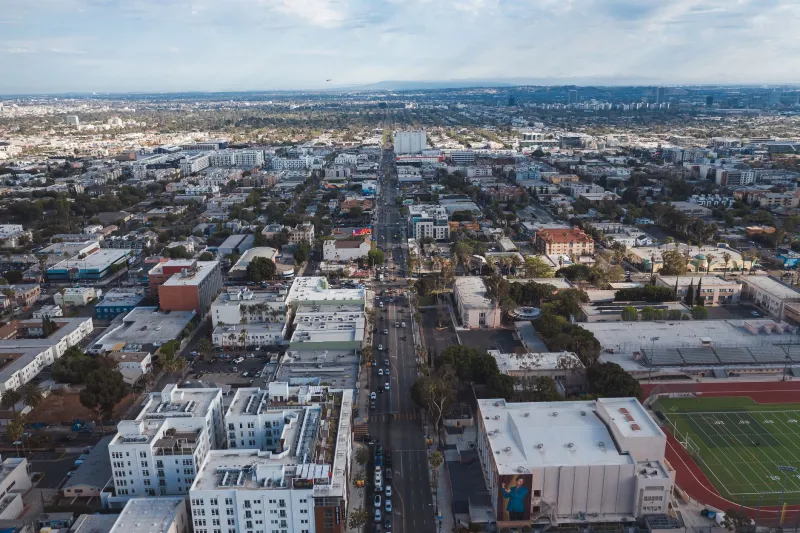
Research published in journals including Environmental Health Perspectives and Nature Communications has documented this pattern in cities across the United States. In Los Angeles, communities near the I-710 freight corridor—predominantly lower-income and Latino—experience noise levels that regularly exceed federal guidelines. In Chicago, the South Side neighborhoods that absorbed decades of industrial zoning continue to carry that acoustic legacy. In New York, the distribution of flight path noise across the five boroughs maps with uncomfortable precision onto income and racial demographics.
The mechanism is not conspiratorial; it is the ordinary operation of market forces. But the outcomes are no less inequitable for being market-produced.
What Premium Buyers Are Actually Purchasing
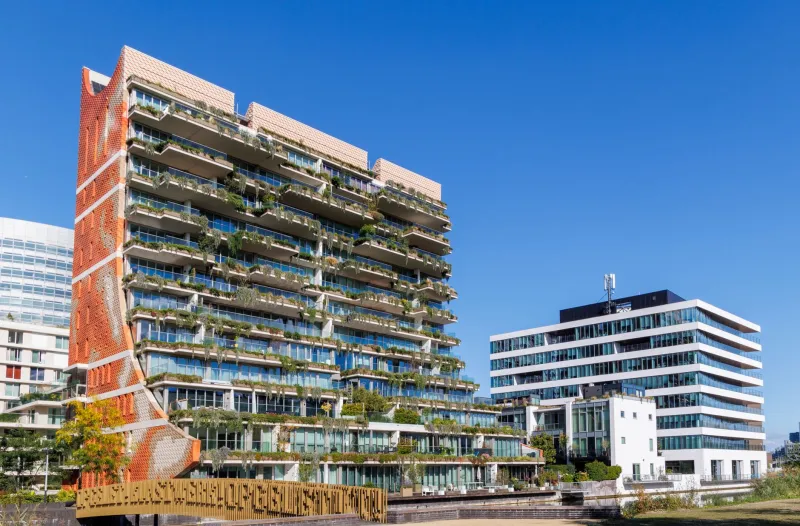
Understanding acoustic inequality requires examining what the upper end of the residential market has quietly made standard. In premium urban developments, noise mitigation is no longer incidental—it is engineered.
High-performance window assemblies with triple-pane glazing and thermal breaks attenuate exterior noise by 40 to 50 decibels in some specifications. Concrete podium construction, mass timber framing, and resilient channel systems between floor-ceiling assemblies reduce both impact and airborne sound transmission between units. Mechanical systems—HVAC, plumbing, elevator equipment—are isolated on vibration-dampening mounts to prevent structure-borne noise from traveling through the building envelope.
These are not exotic technologies. They are available at virtually every price point. What varies is whether developers choose to deploy them—and that choice is strongly correlated with the income level of the intended resident. Affordable housing construction, constrained by per-unit cost limits, routinely omits the acoustic upgrades that luxury buildings treat as baseline. The resident who can afford $4,500 per month in rent sleeps in engineered quiet. The resident in a subsidized unit three miles away sleeps through whatever the street provides.
The Public Health Ledger
The health consequences of this disparity are not abstract. Studies conducted in urban environments across the United States consistently link residential noise exposure to measurable outcomes: elevated cortisol levels, higher rates of hypertension, reduced cognitive performance in school-age children, and increased incidence of anxiety and depression among adults.
A 2022 analysis of data from the American Housing Survey found that lower-income renters were significantly more likely to report noise as a serious problem in their homes than higher-income renters—a gap that persisted across metropolitan areas and housing types. The same analysis found that noise complaints among lower-income renters were substantially less likely to result in remediation than equivalent complaints in premium buildings, where responsive property management is a competitive differentiator.
The cumulative effect is a population that experiences not only the direct health consequences of chronic noise exposure but also the secondary stress of living in an environment that is difficult to control and that institutions have limited incentive to improve.
Planning Interventions and Their Limits
Urban planners have developed a range of tools for addressing noise inequality, with varying degrees of effectiveness. Noise barriers along highway corridors represent the most visible intervention—and one of the most fraught. The communities that most need acoustic buffering are frequently the ones with the least political capital to secure infrastructure investment. Where barriers are built, they often protect the corridor-adjacent properties that subsequently gentrify, pricing out the residents the intervention was nominally designed to serve.
Zoning reform offers more structural promise. Several cities have moved to restrict new residential development in the highest-noise zones, require acoustic impact assessments as a condition of permitting, or mandate minimum performance standards for sound insulation in all new residential construction regardless of price point. New York City's updated noise code and the acoustic provisions embedded in California's Title 24 energy code represent meaningful steps in this direction, though enforcement remains inconsistent.
At the neighborhood scale, urban forestry and green infrastructure provide modest but real acoustic benefits. Dense tree canopy and vegetated barriers absorb and scatter sound waves, reducing ambient noise levels by several decibels in well-documented cases. These interventions are relatively inexpensive and produce co-benefits in air quality and urban heat mitigation—making them attractive candidates for targeted investment in high-noise, lower-income neighborhoods.
The Responsibility of Developers
For private residential developers, acoustic equity presents both a challenge and an argument for elevated baseline standards. The cost differential between standard and high-performance acoustic construction is meaningful but not prohibitive—typically in the range of three to eight percent of total construction cost, depending on specification level and building type. In a market where acoustic comfort commands measurable rent premiums at the upper end, the business case for investing in it across all price points is stronger than the industry's current practices suggest.
More broadly, developers operating in urban markets bear some responsibility for the acoustic environments their buildings create, not only internally but for surrounding properties. Construction noise, mechanical equipment exhaust, and the traffic generated by large residential developments all affect the acoustic quality of neighboring streets. Thoughtful site planning, equipment specification, and construction scheduling can meaningfully reduce those externalities—choices that reflect a developer's relationship to the city rather than merely to its own asset.
The conversation about urban inequality in American cities has grown more sophisticated in recent years, encompassing not only housing affordability and transit access but also environmental justice dimensions including air quality, green space, and heat exposure. Acoustic conditions belong in that conversation. The right to a reasonably quiet home is not a luxury. It is a precondition for health, cognitive function, and basic human dignity—and the degree to which that right is currently priced rather than guaranteed represents one of urban real estate's most consequential unresolved questions.