Beyond the Green Label: A Candid Assessment of Sustainability Certifications and Their Real-World Returns in Urban Housing
The language of sustainability has become so pervasive in urban residential marketing that the word itself has begun to lose precise meaning. Developers invoke it broadly; certification bodies define it narrowly; and residents navigate the gap between the two with varying degrees of success. LEED plaques appear in lobbies across the country. Passive House diagrams populate sales brochures. Energy Star ratings anchor leasing conversations. But how much of what these designations promise actually materializes in a resident's daily experience—and on their monthly utility statement?
This is not an argument against green building. The environmental case for reducing the carbon footprint of the built environment is well established, and the residential sector's contribution to national energy consumption is substantial. Rather, this is an attempt to examine the sustainability conversation with the precision it deserves, separating features that deliver measurable returns from those that function primarily as marketing infrastructure.
Understanding the Certification Landscape
The three frameworks most frequently cited in US urban residential development each operate according to distinct philosophies, and understanding their differences is essential to evaluating their claims.
LEED—Leadership in Energy and Environmental Design—is a point-based system administered by the US Green Building Council. Projects accumulate credits across categories including energy efficiency, water use, materials sourcing, and indoor environmental quality, ultimately achieving Certified, Silver, Gold, or Platinum status. LEED's breadth is simultaneously its strength and its limitation. A building can achieve Gold certification while prioritizing credits in categories that have limited impact on resident utility costs. The system rewards holistic performance but does not guarantee that any single dimension of sustainability will be exceptional.
Passive House, by contrast, is a performance standard rather than a points system. Certification requires a building to meet specific, measurable thresholds for air leakage, heating and cooling demand, and primary energy consumption. There is no partial credit for good intentions. Either the building performs to the standard or it does not. This rigor makes Passive House one of the most demanding—and most verifiable—certifications available, though it also makes it more expensive to achieve and less common in the US market than LEED.
Energy Star certification, administered by the Environmental Protection Agency, focuses specifically on energy performance. Residential buildings that earn the designation must demonstrate energy use at least 35 percent below the national median for comparable structures. Unlike LEED, Energy Star makes a relatively direct and testable claim about operating costs—one that residents can, in principle, verify against their actual utility bills.
Where the Numbers Diverge From the Narrative
The most persistent criticism of green building certifications is the gap between projected and actual energy savings. This gap has been documented in multiple independent studies, including analyses conducted by institutions with no stake in the outcome. The phenomenon has a name in the field: the performance gap.
Several factors contribute to it. Certification assessments frequently rely on modeled energy performance rather than measured performance. Models make assumptions about occupant behavior—thermostat settings, appliance use, ventilation habits—that do not always reflect how people actually live. A building designed for exceptional efficiency can underperform its projections if residents override automated systems, leave windows open during mechanical cooling cycles, or simply use more energy than the model anticipated.
Procurement also plays a role. Some developers pursue certification primarily for its marketing value, selecting credits that are relatively inexpensive to achieve rather than those that drive the greatest operational performance. The result is a certified building that is genuinely more sustainable than an uncertified comparable but may not deliver the utility savings that residents expect based on marketing materials.
This is not universal. Passive House buildings, when properly constructed and verified, have demonstrated heating energy reductions of 60 to 90 percent relative to conventional construction in multiple US case studies. The performance gap is narrowest where the certification methodology is most specific and where third-party verification is most rigorous.
The Resident Perspective: What Long-Term Occupants Report
Conversations with residents of green-certified urban buildings reveal a consistent pattern. In the first year of occupancy, many report a disconnect between expectations set during the leasing process and the utility costs they actually incur. The gap is often modest—perhaps 15 to 20 percent savings rather than the 40 percent implied in marketing materials—but it registers as a credibility issue that shapes how residents perceive the building's broader claims.
Over time, however, the conversation tends to shift. Residents who remain in certified buildings for three or more years frequently report that the financial returns, while perhaps overstated initially, do accumulate meaningfully. They also identify benefits that were not prominently featured in the original marketing: more consistent indoor temperatures, better air quality particularly during high-pollution periods, and reduced drafts and moisture issues that affect comfort and health in ways that are difficult to quantify but easy to appreciate.
This pattern suggests that the most honest marketing of green buildings would foreground long-term comfort and indoor environmental quality alongside energy savings—and would calibrate utility projections conservatively rather than optimistically. Residents who enter with accurate expectations tend to become advocates. Those whose expectations are mismanaged tend to become skeptics, regardless of the building's actual performance.
Where Sustainability Investment Creates Genuine Value
Certain green building features consistently demonstrate clear and durable returns in the urban residential context.
High-performance building envelopes—continuous insulation, thermally broken window assemblies, and carefully detailed air barriers—reduce the energy required to maintain comfortable interior conditions regardless of exterior climate conditions. In cities with extreme seasonal temperature swings, such as Chicago, Denver, or Minneapolis, the operational savings from a well-executed envelope are substantial and ongoing. Unlike many amenity investments, envelope performance does not depreciate.
Heat recovery ventilation systems, standard in Passive House construction and increasingly common in LEED Gold and Platinum buildings, deliver fresh air while recovering a significant portion of the energy that would otherwise be lost through exhaust. In urban environments where outdoor air quality is variable, the ability to ventilate continuously without compromising thermal comfort or energy efficiency is a genuine quality-of-life advantage.
Water efficiency measures—low-flow fixtures, greywater systems, and drought-tolerant landscaping—deliver savings that are particularly meaningful in water-stressed metros in the American West and Southwest, where municipal water costs have risen sharply in recent years.
Where the Performance Remains Largely Performative
Not all green building features deliver equivalent returns. Certain elements appear more frequently in marketing materials than in utility statements.
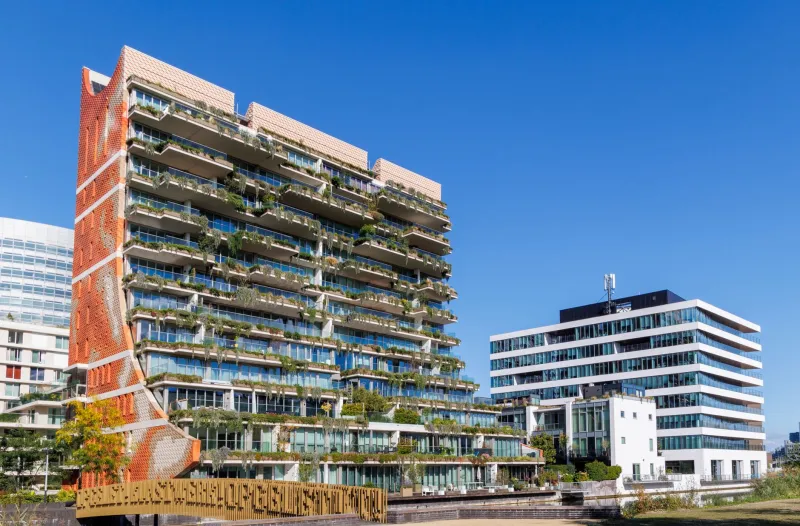
Rooftop solar installations on large multifamily buildings often generate electricity that offsets common area loads rather than individual unit costs, meaning residents see limited direct financial benefit. Green roofs contribute to stormwater management and urban heat island reduction—real environmental benefits—but rarely translate to measurable savings for individual residents. Bike storage rooms and EV charging stations signal sustainable values but depend entirely on resident adoption to deliver any meaningful environmental impact.
This does not make these features worthless. Signaling matters in a market where values alignment influences leasing decisions. But residents and developers alike are better served by a clear-eyed accounting of which investments reduce costs, which improve health and comfort, and which primarily communicate a commitment to sustainability without delivering it in measurable form.
The Path Toward Honest Green Marketing
The urban residential market is sophisticated enough to reward transparency. Developers who publish actual post-occupancy energy data, who present utility projections with appropriate ranges rather than single optimistic figures, and who distinguish between environmental benefits and resident financial returns are building a more durable form of credibility than those who rely on certification logos alone.
The green label, at its best, is a starting point for a conversation—not a conclusion. The most valuable sustainability investments are those that residents can feel on a winter morning when the building holds its temperature without straining the heating system, and those they can see on a utility bill that is meaningfully lower than what they paid in their previous apartment. Everything else is context.