The Urban Convenience Paradox: When a Prime Address Becomes a Liability

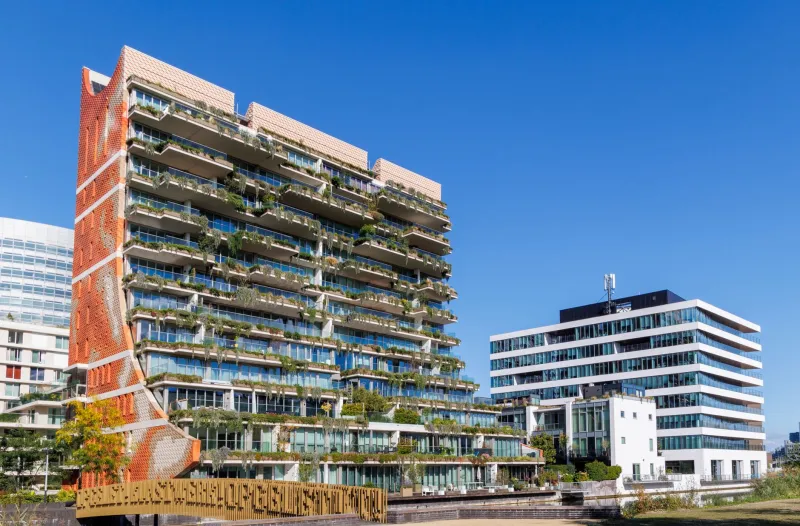
Photo: PattayaPatrol, CC BY-SA 4.0, via Wikimedia Commons
The pitch is familiar and, on its surface, compelling. Walk to work. Walk to dinner. Walk to the farmer's market, the gym, the transit hub, and the dry cleaner. The fifteen-minute city—that aspirational framework in which daily life unfolds within a compact, walkable radius—has become one of the most powerful marketing constructs in contemporary urban real estate. Buyers pay substantial premiums to live at the center of it.
What the marketing materials seldom address is what it sounds like at two in the morning when the bar on the ground floor empties onto the sidewalk. Or what the air quality readings look like on a Tuesday afternoon at an intersection served by four bus lines and a delivery corridor. Or what happens to resale velocity when a neighborhood's density of street-level activity crosses from vibrant into overwhelming.
This is not an argument against urban living. It is an argument for a more honest accounting of what urban living, at its most concentrated, actually involves—and for a more sophisticated understanding of where genuine value lies within the urban landscape.
The Premium That May Not Hold
Property values in America's most walkable urban neighborhoods have, for most of the past two decades, appreciated reliably. The correlation between Walk Score and sale price is well-documented. Buyers and investors have internalized this relationship to the point where walkability has become a near-automatic proxy for quality.
But disaggregating that correlation reveals important nuance. Not all walkability is equivalent in its effect on resident satisfaction or long-term value retention. A neighborhood that scores ninety-eight on walkability because it sits above a transit interchange, adjacent to a nightlife district, and across from a major hospital emergency entrance is a fundamentally different living environment than one that scores ninety-two because it is within walking distance of a grocery store, several restaurants, and a public park.
Recent data from markets including Chicago's River North, Seattle's Belltown, and Miami's Brickell corridor suggest that certain ultra-dense, high-amenity urban neighborhoods are experiencing what analysts cautiously describe as value stagnation relative to slightly less central, but more livable, adjacent areas. The pattern is not uniform, and the causal factors are genuinely complex. But the directional signal is consistent enough to merit attention from anyone making a significant real estate decision in a major American city.
What Buyers Are Actually Saying
Buyer remorse is an underreported phenomenon in residential real estate, partly because sellers have little incentive to publicize it and partly because buyers themselves are reluctant to acknowledge a decision that may represent the largest financial commitment of their lives. Nevertheless, survey data and anecdotal evidence from relocation specialists paint a consistent picture.
Noise ranks as the most frequently cited source of post-purchase dissatisfaction among urban condo buyers, according to multiple surveys conducted by residential satisfaction research firms over the past several years. Not crime. Not commute time. Not unit size. Noise. The ambient roar of street-level activity—delivery trucks, rideshare pickups, outdoor dining, transit operations—is the externality that buyers most consistently underestimate during the purchasing process and most consistently resent after moving in.
Air quality is a secondary but growing concern, particularly among buyers with young children or respiratory sensitivities. Urban air quality has improved substantially in most American cities over the past several decades, but hyperlocal variation remains significant. A unit facing a loading dock or a high-frequency bus corridor can register particulate levels meaningfully higher than a unit two blocks removed from the same intersection—a distinction that is rarely surfaced in property disclosures or marketing materials.
Light pollution and congestion-related stress round out the most commonly cited quality-of-life concerns. The cumulative effect of these factors on daily wellbeing is not trivial, and their effect on resale dynamics—while difficult to isolate—is beginning to appear in the data.
The Developer Response: Strategic Positioning and Design Intervention
A segment of the development community has begun treating these externalities not as unavoidable costs of urban density but as design problems with architectural solutions.
Passive acoustic design—the use of triple-glazed windows, staggered floor plates, and mechanically ventilated facades that allow units to remain sealed against street noise without sacrificing air circulation—has moved from a niche specification to an increasingly standard feature in new urban residential construction. Some developers are commissioning acoustic studies prior to site acquisition, using noise mapping data to inform unit orientation and pricing strategy before a single permit is filed.
Building setbacks and podium landscaping are being reconsidered as buffers rather than purely aesthetic elements. A ten-foot planted setback between a building's ground floor and a high-traffic arterial does measurable work in attenuating both noise and particulate exposure for residents in lower floors. It also creates a perceptible transition between the intensity of the street and the relative calm of the residential environment—a psychological benefit that is difficult to quantify but consistently valued by residents.
Strategic urban positioning is perhaps the most consequential variable of all. Developers with deep market knowledge are identifying locations that capture the connectivity benefits of central urban addresses—proximity to transit, walkable retail, employment centers—while maintaining sufficient distance from the most disruptive generators of noise and congestion. This is not suburban compromise. It is urban precision.
Reading the Market More Carefully
For buyers and investors evaluating urban residential properties, the practical implications of this analysis are straightforward, if not always easy to execute.
Visit prospective properties at multiple times of day and on different days of the week. A building that feels serene on a Wednesday morning may be substantially less so on a Friday evening. Examine the immediate surroundings with attention to land uses that generate noise, traffic, and activity at hours when you will be home: bars, transit hubs, hospitals, entertainment venues, and freight corridors all have distinct temporal signatures.
Request whatever environmental data is available. Noise ordinance complaint records, air quality monitoring data from the nearest EPA sensor, and traffic volume counts for adjacent streets are all matters of public record in most jurisdictions. They are rarely volunteered, but they are rarely withheld when specifically requested.
Finally, consider the trajectory of the surrounding neighborhood rather than only its current state. A block that is presently quiet because it contains underutilized commercial space may look very different in three years if that space is entitled for a major entertainment or retail use. Urban environments are dynamic, and the externalities embedded in a particular address are not static.
Toward a More Honest Urban Premium
The walkability premium is real, and it is likely to persist in some form for the foreseeable future. The structural forces driving demand for urban living—demographic patterns, employment concentration, environmental preference—have not reversed. But the premium is not uniform across all urban addresses, and the gap between the most livable urban locations and the most merely convenient ones appears to be widening.
At West City by Vajra, the analysis of urban residential value has always accounted for what a location delivers alongside what it demands. The best urban addresses are not simply those closest to the most amenities. They are those that offer genuine connectivity without the externalities that quietly erode quality of life and, ultimately, long-term asset value. That distinction—between urban convenience and urban livability—is one that every serious buyer and investor would be well served to understand.