Density and the Mind: How Urban Architecture Is Finally Confronting the Psychological Cost of City Living

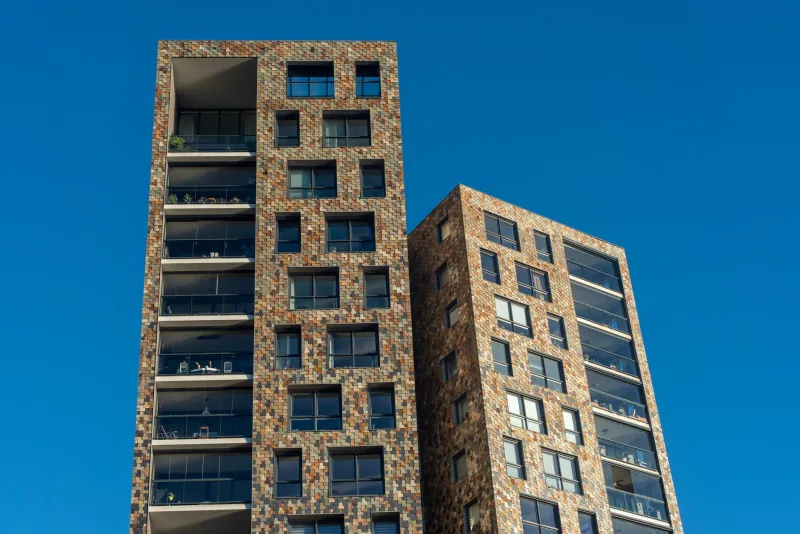
Photo: שלמה רודד, CC BY 2.5, via Wikimedia Commons
For decades, the pitch for urban living rested on a familiar set of promises: proximity, energy, opportunity. The city was sold as a place where everything converged, and the density that made that convergence possible was treated as a feature rather than a condition to be managed. That framing is beginning to shift.
A growing body of interdisciplinary research—drawing from environmental psychology, neuroscience, and public health—is producing findings that the development community can no longer comfortably ignore. High-density urban environments, when poorly designed, are measurably correlated with elevated stress markers, diminished cognitive restoration, and what researchers increasingly describe as "urban fatigue." The question is no longer whether density affects mental health. The question is what responsible developers are doing about it.
What the Research Actually Shows
Studies published over the past decade have documented a consistent pattern: urban residents report higher baseline anxiety than their suburban or rural counterparts, even after controlling for income, employment, and social factors. A 2011 landmark study in Nature demonstrated that individuals raised in cities show heightened activity in the amygdala—the brain's threat-detection center—when placed under social stress. More recent work from institutions including Harvard's T.H. Chan School of Public Health has connected chronic noise exposure, limited access to natural light, and the absence of restorative green space to measurable declines in executive function and emotional regulation.
None of this indicts urban living categorically. What it does indict is the default approach to urban building design—one that has historically prioritized unit count, amenity optics, and street-level activation over the quieter, less photographable qualities that actually sustain human wellbeing over time.
The Architecture of Recovery
The buildings that are beginning to differentiate themselves in this conversation share several characteristics, and they are worth examining in detail.
Acoustic separation remains among the most undervalued design interventions available to developers. Research consistently identifies uncontrolled noise—particularly low-frequency, intermittent sound from traffic, mechanical systems, and neighboring units—as one of the primary drivers of urban stress. Buildings that invest in mass-loaded assemblies, decoupled floor-ceiling systems, and carefully engineered window glazing are not simply offering comfort. They are removing a chronic physiological stressor that compounds over months and years of occupancy.
Biophilic design, a term that has occasionally been reduced to a marketing shorthand for potted plants in lobbies, carries genuine empirical weight when applied rigorously. The research of environmental psychologist Roger Ulrich and the subsequent development of Attention Restoration Theory by Rachel and Stephen Kaplan established decades ago that exposure to natural elements—water, vegetation, natural light, views of landscapes—measurably reduces physiological stress and accelerates cognitive recovery. Developments that incorporate living walls at scale, courtyard gardens accessible to all residents, and units designed to maximize daylight penetration are offering something functionally different from those that treat greenery as decoration.
Refuge spaces—a concept borrowed from evolutionary psychology—refer to environments that provide a sense of enclosure, safety, and reduced stimulation. In a residential building context, this might manifest as alcoved reading areas in common spaces, lower-ceiling zones within amenity floors, or carefully proportioned unit layouts that create distinct zones of retreat within the home itself. These are not luxury flourishes. They are spatial responses to the neurological reality that the human brain requires periodic withdrawal from the stimulation-rich urban environment to function at full capacity.
Where the Premium Is Forming
The market is beginning to price this distinction. In cities including New York, Chicago, Seattle, and Washington, D.C., a discernible tier of residential developments has emerged that positions mental-health-conscious design as a core value proposition rather than an ancillary selling point. These buildings tend to share a few observable traits: higher-than-average ceiling heights in both units and common areas, meaningful outdoor space at multiple building levels rather than a single rooftop amenity, and deliberate restraint in the programming of shared spaces—quieter, less activated environments that residents can actually use for recovery rather than performance.
Analysts tracking absorption rates in urban residential markets have noted that buildings in this category are maintaining stronger occupancy and lower turnover than comparably priced developments whose amenity offerings skew toward social and entertainment programming. Resident retention, it turns out, is significantly influenced by whether a building allows people to rest—not simply whether it provides them with reasons to stay engaged.
The Developer's Responsibility
There is a meaningful difference between a development that markets wellness and one that is structurally designed to support it. The former category is crowded. The latter remains relatively rare, and that scarcity is itself a market signal.
Developers who are serious about this distinction are beginning to engage environmental psychologists and neuroscientists during the schematic design phase rather than in the final stages of interior specification. They are commissioning post-occupancy evaluations that measure resident-reported wellbeing alongside more conventional satisfaction metrics. Some are pursuing WELL Building Standard certification, which provides a framework for evaluating the built environment's impact on human health across categories including air, water, light, movement, and mind.
These commitments carry cost. But the evidence increasingly suggests they also carry return—in the form of stronger lease-up velocity, lower vacancy, and the kind of resident loyalty that sustains long-term asset performance.
A More Honest Conversation About Urban Living
Urban density is not going to diminish. American cities are continuing to grow vertically, and the residential demand that supports that growth is not abating. What is changing is the sophistication of the residents navigating that market. A generation that has lived through pandemic-era confinement, that is more conversant with mental health as a concept than any preceding cohort, and that has experienced firsthand the difference between a home that restores and one that merely houses—this generation is asking different questions of the buildings it considers.
At West City by Vajra, we believe that the future of urban residential development belongs to projects that take those questions seriously. Not as a branding exercise, but as a design mandate. The invisible commute—the daily psychological toll of an environment that was never engineered for human flourishing—is a cost that residents have been absorbing quietly for too long. The buildings that eliminate it are not simply better places to live. They are better investments.